Design Thinking for Startups
From Problems to Opportunities | UNPHU Santo Domingo 2022
Facilitator: Sarah Tió

What does design have to do with solving startup problems?
And perhaps the bigger question:
What is an architect doing facilitating an Entrepreneur Bootcamp?
Quite a lot, actually.
Through my background and curiosity around design, I discovered Design Thinking — and with it, a much broader understanding of what it means to design.
Design is not only about buildings, interiors or objects.
We can design products, services, systems and experiences.
After exploring the methodology, studying different applications and becoming certified in Design Thinking, I became particularly interested in taking these tools beyond architecture and interior design.
In other words: using design to help people think a little more #OutOfTheBox.
Less Thinking. More Doing.
Despite its name, Design Thinking is actually much less about thinking and much more about doing.
It is a human-centred methodology for approaching complex problems through observation, experimentation and iteration.
Instead of immediately jumping into a solution, we begin by trying to understand the person we are designing for.
What do they need?
What frustrates them?
What do they value?
What are they trying to accomplish?
Because innovation is not simply about creating something new.
It is about creating something that matters to someone.
When Is Design Thinking Useful?
Not every problem needs Design Thinking.
It becomes particularly interesting when uncertainty is high and the problem itself is difficult to define.
These are sometimes called wicked problems.
Imagine asking:
How do we solve traffic in the city centre?
There is no single correct answer.
Before designing the solution, we first need to understand which problem we are actually trying to solve.
The same happens with startups.
Sometimes the challenge is not finding a better solution.
Sometimes it is discovering the right problem.
The Five Steps
The methodology moves through five fundamental actions:
01 — Empathise
Understand the user.
Observe their context, behaviours, frustrations, needs and motivations before making assumptions about what they want.
02 — Define
Organise what we have learned and identify the real problem worth solving.
This is where information begins to become insight.
03 — Ideate
Generate possibilities without immediately judging them.
At this stage, quantity matters. Sometimes the idea that initially sounds the strangest is precisely the one that opens a new direction.
04 — Prototype
Make the idea tangible.
A prototype allows us to move from “I think this could work” to something that can actually be experienced, discussed and challenged.
05 — Test
Put the solution in front of people.
Learn from what works, what doesn’t and what needs to change — and then return to the process.
Design Thinking is not linear. It is iterative.
From Startups to People
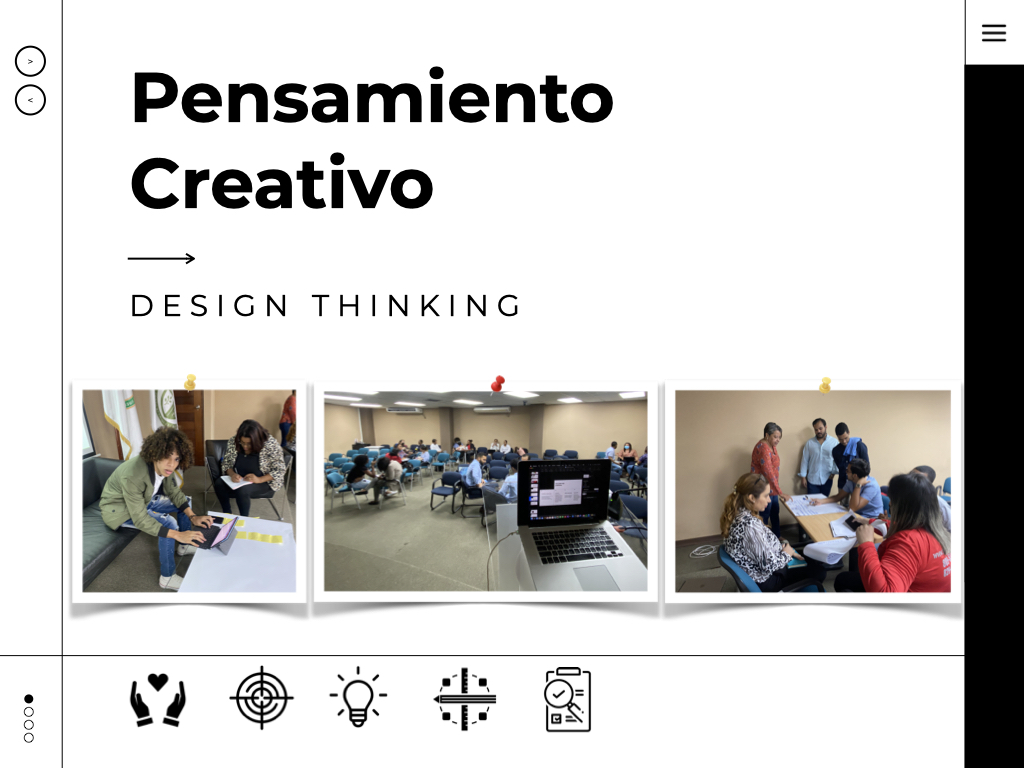
During the Entrepreneur Bootcamp, 17 ventures participated in the Design Thinking workshop.
Participants were organised into small groups, bringing together businesses from different industries but often facing surprisingly similar challenges.
And that was precisely the point.
The methodology does not begin with the industry.
It begins with the person.
By identifying shared problems, generating ideas, prototyping possible solutions and evaluating them, participants could approach their businesses from another perspective — not only asking what they wanted to sell, but what kind of value and experience they wanted to create.
Designing Beyond Architecture
This is what continues to interest me most about Design Thinking.
The process can move between disciplines.
A building.
A service.
A product.
A business.
The output changes, but many of the questions remain the same.
Who are we designing for?
What do they actually need?
What problem are we solving?
And how can we test whether our idea really works?
Maybe that is what an architect was doing at an Entrepreneur Bootcamp after all.
Design Thinking · Entrepreneurship · Innovation · User Experience · Problem Solving · Strategy


I’m always open to new projects, meaningful, collaborations or a good conversation.
Let’s connect.